
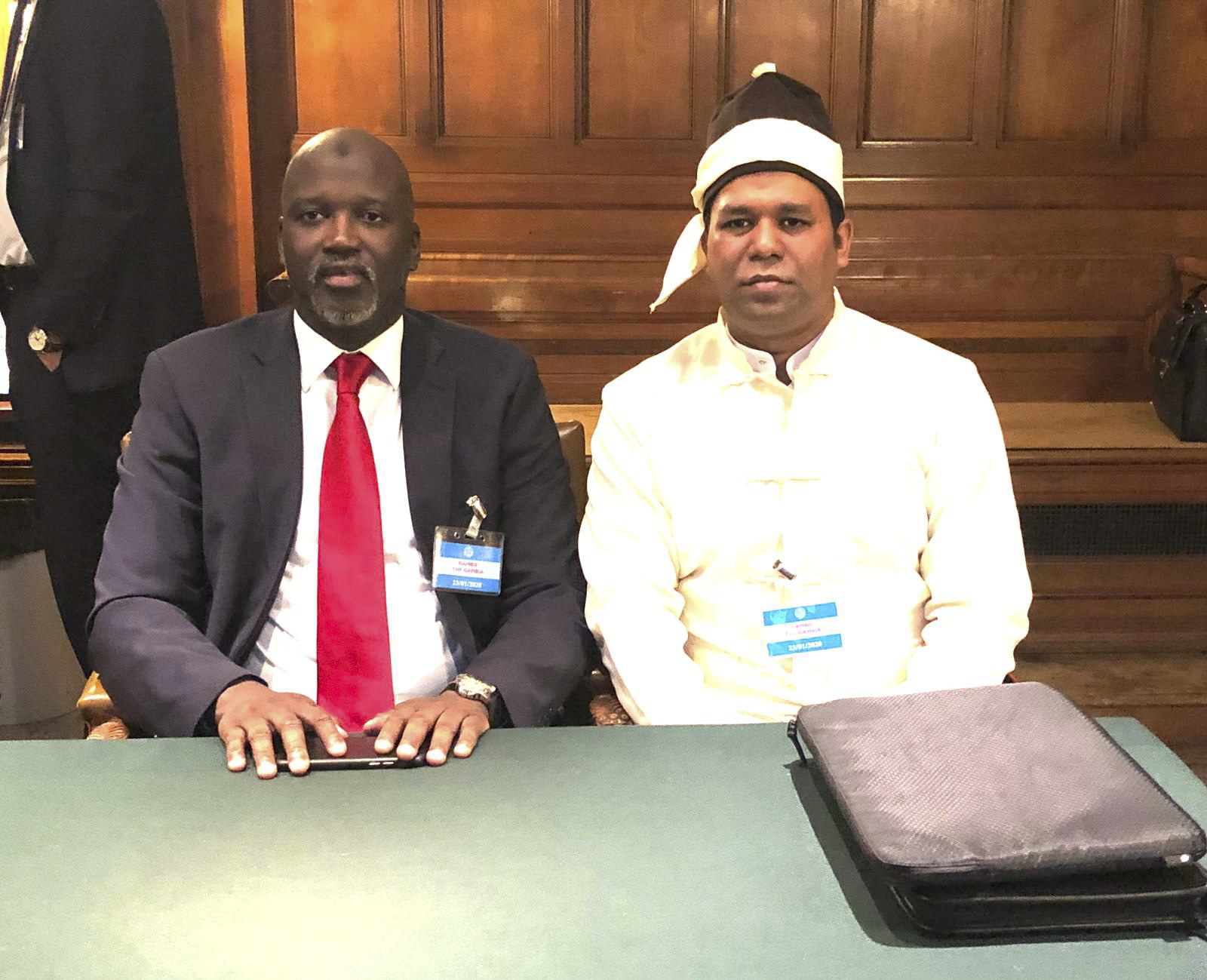
The BROUK president urges international action to enforce the ruling, prosecute military leaders, restore Rohingya citizenship, and ensure the safe return of refugees

Abubacarr Marie Tambadou (left), former Attorney General and Minister of Justice of The Gambia, sits alongside Tun Khin (right), President of the Burmese Rohingya Organisation UK (BROUK), during the International Court of Justice proceedings in The Hague. Photo: supplied to Arakan Journal.
By Arakan Journal Staff – November 24, 2026.
The International Court of Justice (ICJ) judgment in the genocide case against Myanmar marks a historic moment in the Rohingya people’s decades-long struggle for justice, recognition, and accountability. However, ensuring that the ruling leads to meaningful change will require sustained international pressure, accountability for those responsible, and the restoration of fundamental rights, according to Tun Khin, president of the Burmese Rohingya Organization UK (BROUK).
In an exclusive email interview with Arakan Journal, Tun Khin reflected on the significance of the judgment, describing it as an emotional and historic victory for Rohingya survivors and their families. He stressed that the ruling must now be followed by concrete action, including reparations, criminal prosecutions, an end to persecution, and the restoration of Rohingya citizenship.
He also called on Canada, the United Kingdom, the United Nations, and other governments to strengthen diplomatic pressure on Myanmar’s military leadership and ensure that the Court’s decisions are implemented.
Question 1: Immediate Reaction
Arakan Journal: The ICJ has delivered a historic judgment in the genocide case against Myanmar. What was your immediate reaction when you heard the verdict?
Tun Khin: Hearing the judgment was an incredibly emotional moment. There were many tears in the courtroom. After decades of persecution and fighting for justice, the world’s highest court finally recognized the genocide against our people.
Question 2: Historical Significance
Arakan Journal: How significant is this judgment for the Rohingya people, particularly survivors and families who have waited decades for international recognition and justice?
Tun Khin: Our people have fought for decades to have the crimes committed against us recognized, and finally the world’s highest court has heard us.
The judgment went far beyond the events of 2017. It recognized how we have been dehumanized, stripped of our rights, and denied our very identity over decades. It laid bare how systematic this persecution has been.
Question 3: Accountability and the Road to Justice
Arakan Journal: Does this judgment bring the Rohingya closer to justice, or is it only the beginning of a longer accountability process?
Tun Khin: This is a historic victory and a major step towards justice, but it is only the beginning.
The Court has found Burma responsible for genocide and ordered reparations, including compensation. Now we need to see those orders implemented, those responsible held accountable, and an end to the persecution our people still face.
Question 4: Myanmar’s Responsibility and International Pressure
Arakan Journal: What practical steps should the international community take to ensure that Myanmar complies with the ICJ judgment?
Tun Khin: The Burmese military has already rejected the judgment. Governments must now coordinate action to cut off the weapons, aviation fuel, and money that enable the military to kill civilians.
In the UK, we welcome the Foreign Secretary’s announcement that the Burmese military’s Defence Attaché will be expelled and that the UK will call for urgent UN Security Council action.
These are important first steps, but as penholder in Burma, the UK must lead sustained international efforts to secure implementation of the judgment. BROUK will continue pressing governments to take these steps.
Question 5: Criminal Accountability for Military Leaders
Arakan Journal: The ICJ addresses the legal responsibility of states rather than conducting criminal trials of individuals. What further action should be taken to ensure that military leaders and other individuals responsible for atrocities against the Rohingya face criminal accountability?
Tun Khin: The ICJ has established Burma’s responsibility as a state, but those who committed genocide must also face criminal prosecution.
BROUK initiated a universal jurisdiction case in Argentina in 2019, which led to international arrest warrants against Min Aung Hlaing and 24 others in February 2025. Governments must press INTERPOL to act on these warrants and cooperate to secure arrests and extraditions wherever possible.
We also want progress at the International Criminal Court, where the Prosecutor has requested an arrest warrant for Min Aung Hlaing, and continued efforts to pursue accountability through universal jurisdiction in other countries.
Question 6: Rohingya Citizenship and Fundamental Rights
Arakan Journal: For decades, the Rohingya have faced denial of citizenship, discrimination, and restrictions in Myanmar. Do you believe this judgment can help restore their citizenship and fundamental rights?
Tun Khin: The judgment has recognized the systematic discrimination and denial of rights that Rohingya have faced for decades.
But restoring our rights requires concrete changes, including ending discriminatory citizenship laws, recognizing Rohingya as equal citizens of Burma, and guaranteeing our freedom of movement, access to education and healthcare, and the right to live safely in our homeland.
Question 7: Safe and Voluntary Repatriation
Arakan Journal: Can the ICJ judgment create a genuine opportunity for the safe, voluntary, and dignified return of Rohingya refugees from Bangladesh and other countries to their homeland?
Tun Khin: The court has ordered measures allowing Rohingya to return safely, but conditions on the ground have not changed.
The Arakan Army now controls most of Rakhine State and continues persecuting Rohingya, including seizing our homes and land. Refugees cannot return safely while this continues.
Question 8: Canada’s Role Following the Judgment
Arakan Journal: Canada has supported international efforts to pursue justice for the Rohingya. What further steps should the Canadian government take following this historic judgment?
Tun Khin: We are grateful to Canada for intervening in The Gambia’s ICJ case and for Foreign Minister Anita Anand’s response welcoming the judgment.
However, at the time of writing, the Canadian government has not announced concrete next steps.
Canada must now work with other governments to secure implementation of the judgment, strengthen sanctions against the Burmese military, and support humanitarian aid for Rohingya refugees.
Question 9: Compensation and Reparations
Arakan Journal: What would meaningful reparations, including compensation and restitution, look like for Rohingya survivors and their families?
Tun Khin: No amount of money can bring back those we have lost or undo what our people have suffered.
But survivors deserve compensation, the return of their homes and land, and support to rebuild their lives and communities.
Rohingya survivors must have a leading role in deciding how reparations are delivered, so they can recover what was taken from them and rebuild their lives in their homeland.
Question 10: Future Challenges Facing the Rohingya
Arakan Journal: Despite this historic judgment, Rohingya communities inside Myanmar and in refugee camps continue to face serious challenges. What are your biggest concerns about their future?
Tun Khin: My greatest fear is that Rohingya will be permanently erased from our homeland.
Our people continue to face persecution by both the Burmese military and the Arakan Army, while refugees in Bangladesh and neighbouring countries face appalling conditions and cuts to humanitarian aid.
If we don’t act urgently, there may not be a homeland for them to return to.
About the Interviewee
Tun Khin is the president of the Burmese Rohingya Organisation UK (BROUK), an organization that advocates for the rights, protection, and justice of the Rohingya people. He has been involved in international advocacy efforts seeking accountability for crimes committed against the Rohingya, the restoration of their fundamental rights, and recognition of their identity.
Arakan Journal conducted this exclusive interview to examine the significance of the ICJ judgment and the next steps required to achieve justice, accountability, and a secure future for the Rohingya people.

Leave a Reply