By Arakan Journal Staff – September 30, 2026
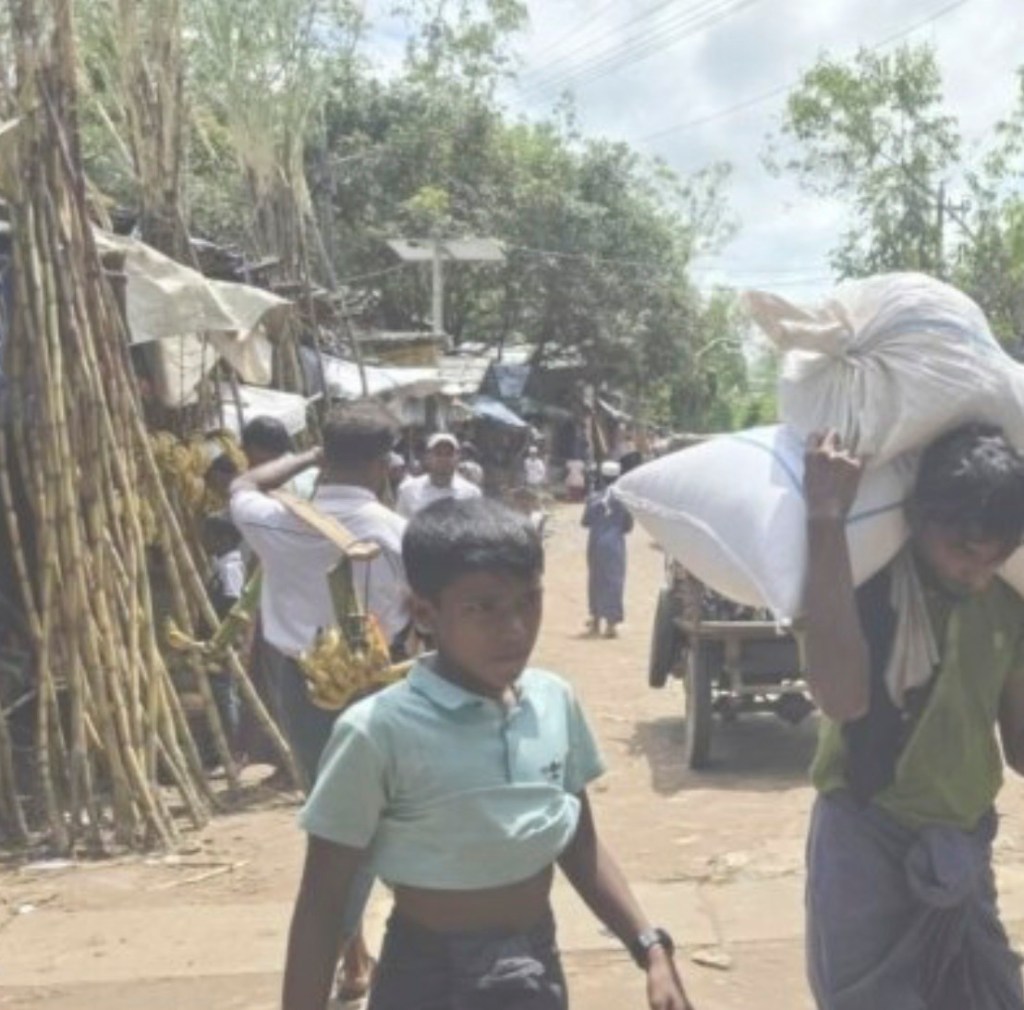
COX’S BAZAR, Bangladesh – Reduced humanitarian food assistance is forcing some Rohingya refugee families in Bangladesh to make difficult choices between food and other essential needs, with children increasingly affected through school dropouts, child labour, and reduced access to healthcare.
The situation comes as humanitarian agencies warn that declining international funding is putting additional pressure on an already vulnerable refugee population. 1.2 million Rohingya refugees live in Cox’s Bazar and Bhasan Char, most of whom depend heavily on humanitarian assistance.
According to a report published by Inter Press Service (IPS) on September 29, the World Food Programme (WFP) introduced a revised Targeting and Prioritization Exercise in April, under which households receive various levels of monthly food assistance according to assessed food insecurity.
The current system provides US$12, US$10 or US$7 per person per month. Households extremely considered food insecure receive the highest allocation, while those classified as food insecure, reported to constitute almost 70 percent of households, receive US$7 per person.
Children bearing the consequences
For some families, the reduction has consequences beyond what they eat.
Mohammed Dullah, a 59-year-old Rohingya refugee living with a family of nine, told IPS that the reduction in assistance had made it difficult to pay for necessities including clothing, education, and healthcare.
His 15-year-old son has stopped attending school and started working in a market, earning approximately 6,000 taka (about US$49) a month to help support the family.
Dullah also expressed concern about the health and development of his children and grandchildren. An 18-month-old granddaughter needs infant formula after her mother struggled to meet the child’s nutritional needs through breastfeeding.
The experience illustrates how food insecurity can affect children’s education, nutrition, and protection, not only the amount of food available in a household.
Families selling food to cover other expenses
Other refugees interviewed by IPS described similar pressures.
Sawyedul Amin, 34, lives in Lambashia Camp in Kutupalong and receives assistance equivalent to US$10 per person for his household. He has two young children, a sick mother and a wife who has undergone two operations.
He said his family cannot regularly afford foods such as fish and meat and that he sometimes sells part of the household’s food allocation to obtain money for medical and other essential expenses.
The camps have previously documented selling or exchanging portions of food assistance for cash when families have faced reductions in food support.
In 2023, funding shortages led to successive reductions in WFP food assistance, from US$12 to US$10, and later to US$8 per person per month.
Monitoring at the time found deterioration in food consumption and nutrition indicators.
Newly arrived refugees face additional challenges
The situation is particularly difficult for some Rohingya who arrived in Bangladesh more recently.
IPS reported the case of Radia Bala, a 60-year-old widow from a Hindu Rohingya community. She arrived in Bangladesh in 2024 after fighting spread through her area of Rakhine State.
Radia said her family went without food assistance for five months before beginning to receive aid in July. During the period without assistance, she said, the family survived on rice and leafy vegetables.
She is among a large number of more recently arrived refugees who have faced difficulties accessing shelter and humanitarian services.
Radia told IPS that her family eventually began receiving food assistance but that she has had to sell part of the allocation to pay rent.
Her immediate priorities, she said, are food and shelter.
Humanitarian funding under pressure
Humanitarian agencies have repeatedly warned that funding shortages are threatening essential services for Rohingya refugees.
The updated 2026 Joint Response Plan seeks approximately US$710.5 million for Rohingya refugees and host communities in Bangladesh. According to the IPS report, the appeal was around 50 percent funded at the time of publication.
Save the Children has warned that worsening access to nutritious food, healthcare and other essential services is increasing risks for children.
Golam Mostofa, head of Save the Children’s Cox’s Bazar Area Office, told IPS that child-protection monitoring had identified increasing concerns related to child labour and child marriage, alongside other risks affecting children and adolescents.
He cautioned, however, that individual cases of child labour, child marriage, malnutrition, or children leaving learning centres should not automatically be attributed to the latest changes in food assistance.
Save the Children has nevertheless projected that a considerable proportion of refugees could face severe levels of food insecurity later this year.
A prolonged displacement crisis
The Rohingya refugee crisis in Bangladesh has continued for decades, with major refugee movements occurring in 1991–92 and following the massive military-led violence in Myanmar’s Rakhine State in 2017.
More recently, renewed fighting in Rakhine State has driven additional Rohingya across the border into Bangladesh.
With refugees unable to access formal employment, humanitarian assistance remains central to meeting basic needs, including food, healthcare, education, water, and sanitation.
The prolonged displacement has also created a generation of Rohingya children who have spent much or all their childhood in refugee camps.
For families with limited resources, reductions in assistance can therefore have consequences extending beyond immediate hunger.
Calls for continued international support
Humanitarian organizations are urging international donors to maintain funding for food assistance while continuing support for education, healthcare, water and sanitation, child protection, and other essential services.
At the same time, Bangladesh continues to call for a sustainable solution to the Rohingya crisis through the safe, voluntary, dignified, and sustainable return of refugees to Myanmar when conditions permit.
For families such as Dullah’s, however, the immediate challenge remains meeting everyday needs.
Until a durable solution becomes possible, many Rohingya families in Bangladesh will continue to depend on humanitarian assistance while trying to keep their children in school, maintain access to healthcare and secure enough food for their households.
Source: Inter Press Service (IPS), “Rohingya Camps: Children in Frontline of Food Rationing Crisis,” September 29, 2026. Additional information attributed in the IPS report to WFP and Save the Children.



Leave a Reply